
Park Court Release Events
Park Combined Court is not a jail roster facility, and it should not be described as one. Its release value is different. Court records can show the legal action that caused a person to leave custody, such as a bond order, minute order, disposition, sentencing order, probation sentence, warrant action, or sentence-completion note. A person released after a hearing may leave the jail list before the court record is fully understood by a family member or record requester.
Because courthouse custody events are tied to the Colorado Judicial Branch and the 11th Judicial District, release confirmation often requires two records. The sheriff's booking and release record can show the jail event. The court docket or court document can show the order, case status, or sentence that explains why the person was released. Those two sources answer different questions and should not be merged.
| Court event | What it can prove | Where to check |
|---|---|---|
| Bond hearing | Bond setting, bond conditions, or custody order. | Park Combined Court docket and court file. |
| Release after bond | Court basis for release, plus local jail release time. | Court record and Park County sheriff release record. |
| Disposition | Conviction, dismissal, plea, sentence, or case outcome. | Court docket and record request form. |
| Probation sentence | Community supervision ordered by the court. | Court record and Park County probation office. |
| Warrant or remand | Whether the court ordered custody or later release. | Court docket, clerk, and sheriff custody record. |
Confirm Park Court Release
The statewide docket search is the first public court path, but it is not a jail release feed. The Colorado Judicial Branch docket search requires at least one filter in addition to date. Search filters include judicial district, county, courthouse, court type, date range, case number, party, business, and attorney. For Park County, the docket can point to hearings, bond status, disposition, sentencing, probation, warrant activity, and later post-sentence events.
- Open the Park County trial court page and use the Park County docket route.
- Search by case number if known, or use county, court type, party, and date filters.
- Read the docket for bond, release order, disposition, sentencing, probation, or warrant entries.
- Use the record/document request form for copies of court documents.
- Ask Park County Jail or the sheriff records route for the exact jail release date and time.
- If the court record shows a state-prison sentence, use CDOC for later prison release and parole details.
A Park Combined Court release order can explain legal status, while the sheriff release record confirms the jail custody event.
Park Court Records Contact
Park Combined Court records are requested through the Colorado Judicial Branch, not through the jail roster. The court page lists the Fairplay courthouse, clerk email, phone, fax, and business hours. The Judicial Branch record request page says the form is used for court records and documents and that a response is generally provided within three business days unless extenuating circumstances exist. It also notes that suppressed, juvenile, probate, confidential, or protected records may require government photo ID or may be restricted.
Park Combined Court
300 Fourth St., P.O. Box 190
Fairplay, CO 80440
Phone: 719-836-2940
Fax: 719-838-4569
Email: parkcountyclerk@judicial.state.co.us
Hours: Monday-Friday 8:00 a.m.-4:30 p.m. except state holidays
For a person released to probation, the local probation contact may matter after the court order. The Judicial Branch lists the Fairplay probation office at 300 4th Street / P.O. Box 504 and a Bailey office at 59865 Hwy 285 / P.O. Box 731. Use the court record for the sentence or disposition, then use probation contacts for supervision logistics.
About Park Combined Court
Park Combined Court serves Park County through Colorado's trial court system. It is a courthouse and case-record source, not a detention center with a public inmate list. Sheriff's deputies may transport or support custody around hearings, but the court itself is not the place to search a live jail roster. The court record matters because it can show the order or disposition that explains why a person left or remained in custody.
The Colorado Judicial Branch Park County page is the official local court source for Park County release-related case records.
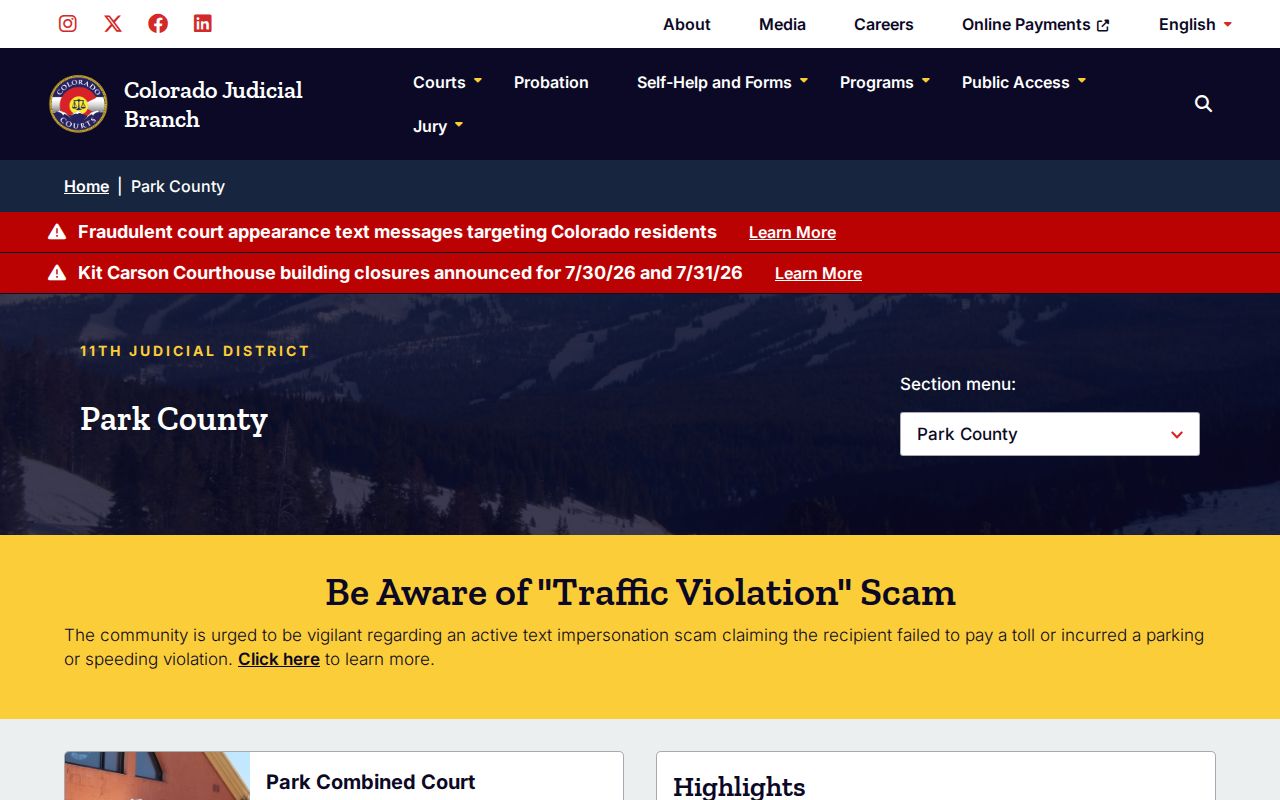
Use that court source for case status and orders, then pair it with sheriff records when exact jail release facts are needed.
Park Court vs Jail Records
The court and jail do not answer the same release question. A Park County Jail record may show the time and reason the person left the facility. The court record may show the bond order, sentence, disposition, probation terms, warrant status, or sealing action. For a clean release verification, use both when the event followed a hearing.
- Bond order
- A court order setting the amount or conditions needed for pretrial release.
- Disposition
- The court outcome, such as dismissal, plea, conviction, or sentence.
- Remand
- A court order sending the person into custody.
- Probation
- Court-ordered community supervision, separate from CDOC parole.
- Sealed record
- A case or record no longer open to the general public under the controlling law or order.
Note: A court disposition can survive after a released person no longer appears on the Park County current-custody list.
Park Court Release Limits
A court search has limits. It may not show the exact minute a person walked out of jail. It may not show all protected details. Juvenile, suppressed, sealed, probate, and confidential records can be restricted. Some details may require a formal court record request or direct contact with the clerk. When the release involved a CDOC sentence, the court record explains the sentence, while CDOC controls later prison release, parole eligibility, and discharge information.
Park County courthouse custody events also do not replace VINE. VINE can help with current custody status and release notifications for covered Park County-charge custody. The sheriff release record, however, is the more direct local source for the booking and release event. The full countywide search path is covered on the Park County released inmates home page.
Timing can also differ between the jail record and the court record. A bond order may appear in the docket before the jail has completed release processing. Park County's bond materials explain that release should occur as soon as practicable after the triggering conditions are met, with a six-hour rule absent extraordinary circumstances and a possible 24-hour electronic-monitoring exception. If the public question is whether the court allowed release, look at the docket or order. If the public question is whether the person physically left Park County Jail, use the jail or sheriff record.
Sealing is another court-specific limit. Colorado court materials explain that sealed records are no longer public in the ordinary way, even though courts, prosecutors, and criminal justice agencies may retain access. That means a person can have a real Park County release or disposition history that no longer appears in public search results. For a requester, the best practice is to ask for the specific record type and be ready for the clerk or sheriff to explain that a statute, rule, order, or protected-record category controls access.